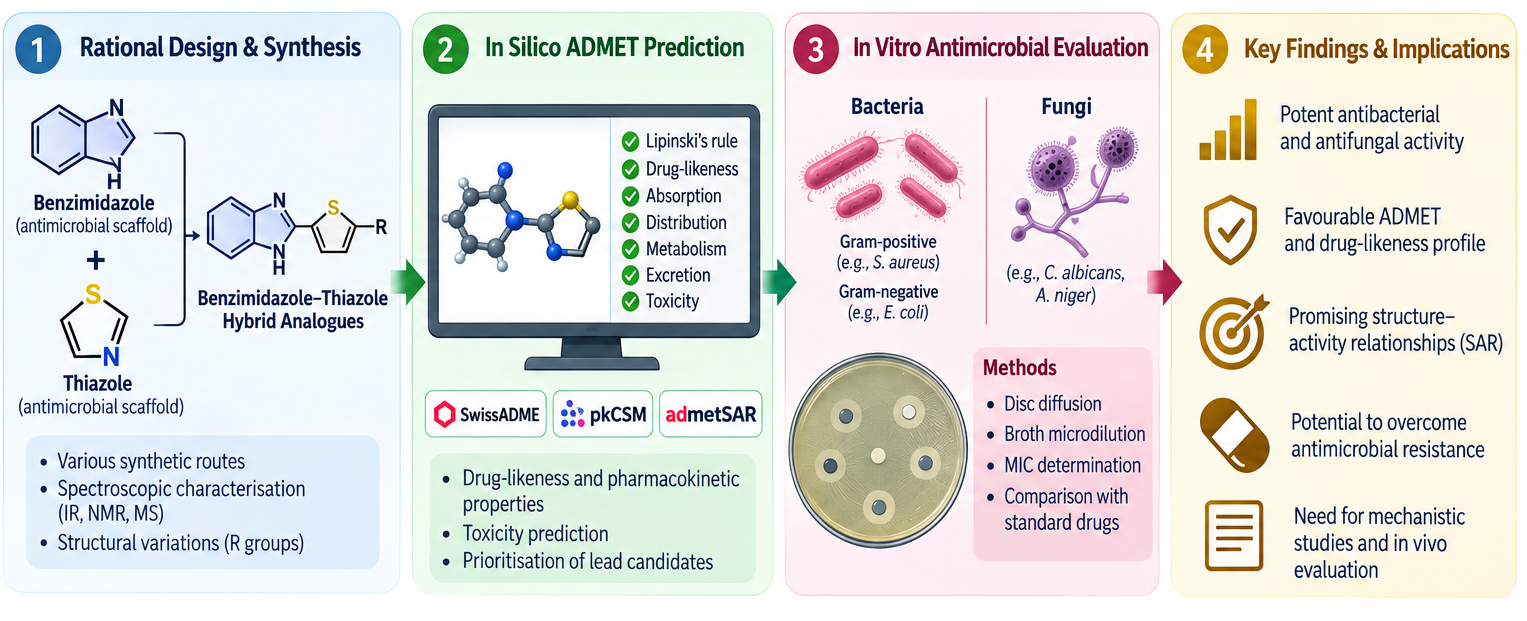
Synthesis, In Silico ADMET Prediction, and In Vitro Antimicrobial Evaluation of Novel Benzimidazole-Thiazole Hybrid Analogues: A Literature Review
Keywords:
- Benzimidazole; Thiazole; Molecular hybridisation; Antimicrobial agents; In silico ADMET; SwissADME; Structure-activity relationship; Drug-likeness; Antimicrobial resistance.
Abstract
Antimicrobial resistance is recognised by the World Health Organization as one of the most pressing global public health threats, driving sustained medicinal chemistry interest in novel heterocyclic scaffolds capable of overcoming existing resistance mechanisms. Benzimidazole and thiazole are both independently established privileged pharmacophores in antimicrobial drug design, present in numerous marketed antibacterial, antifungal, and antiparasitic agents, and their molecular hybridisation into a single benzimidazole-thiazole conjugate has been explored by multiple independent research groups as a strategy for generating novel antimicrobial chemotypes with improved potency or a broadened spectrum of activity. This review consolidates the published literature on the design, synthesis, in silico absorption-distribution-metabolism-excretion-toxicity (ADMET) prediction, and in vitro antimicrobial evaluation of benzimidazole-thiazole and closely related benzimidazole-thiadiazole and benzothiazole-thiazole hybrid analogues. Reported synthetic routes, spectroscopic characterisation strategies, computational ADMET prediction tools, antimicrobial screening methodologies, and structure-activity relationship (SAR) findings are tabulated and critically compared. Across the reviewed studies, hybrid analogues combining the benzimidazole and thiazole (or closely related thiadiazole) rings consistently demonstrate antibacterial and antifungal activity comparable to, and in several specific cases exceeding, standard reference antimicrobial agents against clinically relevant Gram-positive, Gram-negative, and fungal pathogens . In silico ADMET prediction, performed using tools such as SwissADME, pkCSM, and admetSAR, is now a standard component of this literature, typically applied to prioritise or rationalise candidate selection alongside Lipinski's rule of five and topological polar surface area calculations . The review further outlines the principal synthetic strategies used to construct benzimidazole-thiazole hybrids, the standard in vitro antimicrobial susceptibility testing methodologies applied in this field, and the broader pharmacological context established by both parent heterocyclic scaffolds individually. Gaps in the existing literature, including the comparative scarcity of mechanistic target-identification studies and in vivo efficacy data accompanying most reported hybrid analogue discovery studies, are identified, and recommendations for future work are proposed.